Scaling software delivery is traditionally viewed through a linear lens: when the roadmap expands, the team must expand with it. For years, the industry operated under the assumption that adding more developers was the most reliable way to accelerate innovation.
However, this model shows its limits.
Scaling through headcount often introduces a “coordination tax”, a rise in communication overhead, fragmented knowledge, and management complexity that eventually negates the intended productivity gains. Today, if your team is constantly busy but your time-to-market continues to lag, you are likely not facing a talent shortage; you are facing a throughput problem.
This is why the conversation around Offshore Development Centers (ODCs) is shifting. In an AI-driven world, the most important question is no longer how many engineers a technology partner can provide, but how effectively those engineers can deliver measurable business outcomes.
The Hidden Trap of Traditional ODC Scaling
Adding people to a manual or inefficient delivery process rarely solves the underlying problem. More often, it amplifies existing bottlenecks. Common symptoms include:
- Increased communication and coordination overhead.
- Longer onboarding and knowledge transfer cycles.
- Greater dependency on senior engineers for reviews and guidance.
- More rework is caused by inconsistent standards and fragmented knowledge.
For industries such as logistics and F&B, these inefficiencies can have a direct business impact. A delayed route optimization feature can slow operational improvements across a logistics network. A delayed update to a digital ordering platform can affect customer experience across multiple outlets. When engineering delivery slows down, business growth often slows with it.

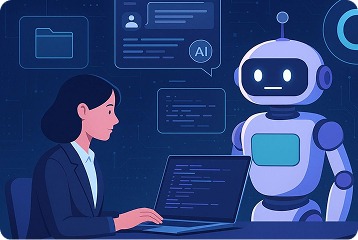
AI Powered ODC Model Is Not Replacing Engineers, It’s Reducing Engineering Waste
One of the biggest misconceptions about AI in software development is that its primary purpose is automation. The real value is efficiency.
AI-powered workflows help engineering teams reduce the manual effort that consumes time but creates little strategic value. Instead of spending hours on repetitive tasks, teams can focus on solving business problems and delivering customer-facing improvements. Areas where AI can improve delivery efficiency include:
- Accelerating requirements analysis and planning.
- Supporting rapid prototyping and validation.
- Streamlining testing and quality assurance.
- Improving documentation and knowledge retention.
- Enhancing project coordination and resource planning.
The result is an ODC that scales by increasing productivity per engineer, not by simply adding more seats.
Metrics That Actually Measure Business Impact
If ODC engineering success is still being measured primarily by team size or hourly rates, the wrong metrics drive the conversation. Leading organizations now focus on indicators that reflect the real ROI of an AI-Powered ODC:
- Cycle Time: How quickly can an idea move from planning to production?
- Time-to-Market: How fast can new features reach customers?
- Feature Throughput: How much value can the team deliver within a given period?
- Quality and Reliability: Can systems scale without creating operational risks?
- Resource Efficiency: How effectively are engineering investments being utilized?
These metrics provide a much clearer picture of engineering ROI than headcount alone.
AI Powered ODC Practical Applications
Modern logistics businesses rely on technology to support route optimization, fleet management, warehouse operations, and supply chain visibility. The faster improvements can be delivered, the faster organizations can respond to changing operational demands. AI-assisted workflows help reduce development friction, shorten delivery cycles, and accelerate decision-making, allowing logistics teams to implement improvements more efficiently.
For F&B businesses, growth increasingly depends on digital experiences, from mobile ordering platforms and loyalty programs to inventory and outlet management systems. As businesses expand, maintaining consistency across multiple locations becomes increasingly challenging. AI-powered delivery helps engineering teams streamline testing, deployment, and knowledge sharing, enabling faster feature releases while maintaining operational reliability.
Building AI Capability Without Creating Additional Overhead
One of the biggest challenges organizations face when adopting AI is not the technology itself, but the capability gap required to implement it effectively. Building governance, upskilling teams, and embedding AI into delivery processes often require significant time and investment.
At BeyondEdge, clients can bypass much of this complexity. We have established a dedicated enablement team responsible for continuously strengthening our developers’ AI capabilities through a structured and ongoing methodology.
This ensures AI is seamlessly integrated into day-to-day engineering workflows, helping reduce repetitive effort, accelerate execution, and improve consistency across projects.
As a result, organizations gain immediate access to AI-augmented engineering talent without the operational burden of building internal AI capabilities from scratch. This allows leadership teams to focus on business growth rather than capability building.
Final Perspective
The future of engineering extensions is not about hiring more people or simply adding more teams. It is about execution speed, delivery efficiency, and measurable business outcomes. At BeyondEdge, we believe an ODC should be more than a capacity provider. It should be a productivity partner, one that helps organizations scale technology delivery without scaling complexity.
Because in the AI era, the teams that win won’t be the ones with most people. They’ll be the ones that deliver the most value.
Does your engineering setup act as a growth engine or a bottleneck?
Let’s audit your delivery pipeline together, we’ll show you exactly where AI-powered workflows can eliminate operational waste and accelerate your path to ROI.
For years, Offshore Development Centers (ODCs) have helped businesses access global talent and scale technology capabilities without building large in-house teams.
Today, however, the challenge is no longer just access to talent. Businesses are under pressure to deliver faster, innovate continuously, and scale efficiently, all without significantly increasing costs or operational complexity.
As a result, organizations are beginning to evaluate ODCs differently. The question is no longer how many engineers a partner can provide, but how effectively those teams can deliver business outcomes.
This shift is driving the next evolution of the ODC model: combining engineering expertise with AI-powered delivery to increase productivity, efficiency, and scalability.
Why the Traditional ODC Model Is Evolving
Software delivery followed a relatively straightforward formula: increase development capacity to increase output.
However, as digital transformation becomes central to business growth, this model begins to encounter diminishing returns. Larger teams often introduce additional communication layers, coordination challenges, and management complexity, slowing down the very initiatives they were intended to accelerate.
Today, businesses face mounting pressure to:
- Launch digital initiatives faster without sacrificing quality.
- Improve delivery efficiency across distributed teams.
- Adapt quickly to changing customer and market demands.
- Scale technology capabilities without proportionally increasing operational overhead.
For industries like logistics and F&B, these challenges are critical. Logistics organizations depend on real-time visibility, route optimization, fleet management, and supply chain coordination to remain competitive. At the same time, F&B businesses must continuously enhance digital ordering experiences, loyalty programs, and multi-location operations while maintaining consistency across hundreds of customer touchpoints.
In both cases, simply adding more developers is no longer the fastest path to growth; the path forward is AI-powered delivery.

From Offshore Talent to AI-Powered Delivery
The traditional ODC model focused primarily on expanding capacity. The emerging model focuses on increasing capability.
Rather than replacing engineering expertise, AI-assisted workflows enhance how software teams operate throughout the delivery lifecycle. By automating repetitive and time-consuming activities, teams can spend more time solving business problems and less time on manual execution.
AI-powered delivery can accelerate:
- Requirements analysis and solution design.
- Rapid prototyping and proof-of-concept development.
- Testing, quality assurance, and deployment processes.
- Documentation and knowledge management.
- Project planning and resource allocation.
By streamlining workflows, reducing manual effort, automating repetitive tasks, engineering teams can dedicate their focus to complex problem-solving and high-impact innovation, delivering more value without a proportional increase in team size.
Scaling Output Without Scaling Complexity
The benefits of AI-powered delivery become most visible when businesses need to scale technology initiatives rapidly. For example.
- In the logistics sector, launching a fleet management platform requires validating requirements, developing prototypes, testing functionality across multiple operational environments, and continuously adapting to changing business needs. AI-assisted workflows help shorten development cycles, reduce rework, and accelerate decision-making, allowing teams to respond more effectively to operational demands.
- For fast-food businesses, scaling digital ordering platforms, loyalty programs, and multi-location operations requires speed and consistency. AI-powered delivery helps streamline testing, deployment, and knowledge sharing, allowing teams to support growth without adding unnecessary operational complexity.
In both scenarios, the objective is not to replace human expertise, but to enhance the effectiveness of your engineering organization.
This is where AI-powered ODCs create a meaningful advantage. Instead of scaling through headcount alone, businesses can scale through improved productivity, better workflows, and more efficient delivery processes.
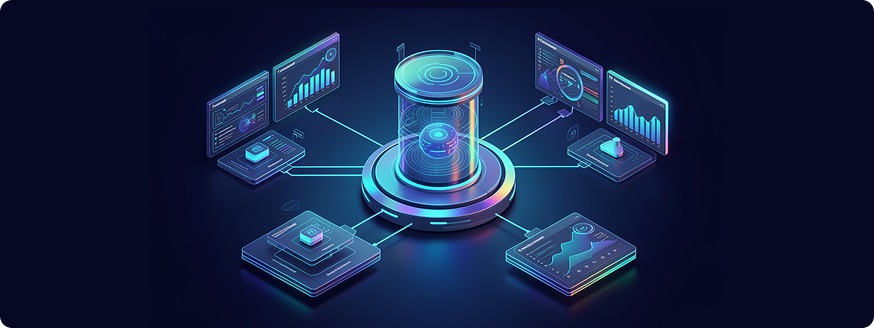
How BeyondEdge Integrates AI Across Delivery
At BeyondEdge, AI adoption is not simply about introducing tools into the development process. It is about embedding AI capabilities directly into everyday engineering workflows.
To support this, we have established a dedicated enablement team focused on continuously equipping our developers with advanced AI capabilities. Instead of one-off training sessions, we follow a structured and ongoing methodology that ensures AI is consistently applied across the software delivery lifecycle.
This allows our engineers to accelerate delivery, improve solution quality, and scale more efficiently while maintaining strong engineering standards.
For our clients, this means immediate access to AI-augmented engineering talent without the need to invest time and resources in building internal AI capabilities from scratch.
In other words, BeyondEdge evolves beyond a traditional ODC provider into a productivity partner that scales engineering capability, not just headcount.
Final Perspective
The evolution of the ODC is no longer defined by geography or labor arbitrage. The next phase of growth is shaped by how effectively organizations integrate AI into their delivery models.
For businesses seeking to accelerate innovation while maintaining efficiency, AI-powered ODCs represent a fundamental shift in how technology capabilities are built and scaled. At BeyondEdge, we don’t just provide engineering capacity, we architect AI-integrated engineering extensions that help you build, scale, and lead in your market.
Ready to transform your engineering architecture? Connect with BeyondEdge today to explore how our AI-powered ODC model can unlock your next phase of growth.
Engineering expansion is no longer just a hiring decision. It is increasingly a cost structure and capital allocation decision.
As manpower costs continue rising in Singapore, many companies are reassessing how engineering teams should scale sustainably. According to recent reporting by Yahoo Finance, manpower cost increases remain one of the biggest business concerns following Singapore’s Budget 2026 updates, particularly as qualifying salary thresholds for Employment Pass (EP) and S Pass holders continue rising, adding more long-term cost pressure for technology companies hiring engineering talent.
When companies evaluate ODC vs in-house development cost, salary comparison is often the starting point. However, the bigger financial impact emerges through operational overhead, hiring scalability, and long-term ROI across multiple growth cycles.
Both models require significant investment, but their cost architecture differs fundamentally. Understanding this distinction is becoming increasingly important for CTOs, CFOs, and founders planning sustainable growth in high-cost markets.
Key Takeaways
- Traditional in-house structures become increasingly expensive and slower to scale as teams grow.
- ODC models create more scalable engineering capacity through global talent access and lower structural overhead.
- Long-term ROI depends less on salary comparison and more on how efficiently engineering organizations can sustain growth over time.
Cost Comparison: ODC vs In-House Engineering
| Cost Dimension | In-House Development Team | Offshore Development Center (ODC) |
|---|---|---|
| Base Compensation | High (local market-driven salaries) | Lower due to offshore labor markets |
| Fully Loaded Cost | ~1.3x – 1.6x of base salary | Typically lower total cost per engineer |
| Hiring Cycle Cost | High (recruitment, onboarding delays) | Lower due to centralized offshore hiring |
| Infrastructure Cost | High (office, equipment, utilities...) | Shared or offshore-managed infrastructure |
| HR & Compliance | Fully internalized | Managed by offshore setup structure |
| Scaling Speed | Constrained by local talent availability | Faster ramp-up via offshore talent pools |
| Cost Flexibility | Low (fixed payroll commitments) | Higher (more scalable resource allocation) |
| Long-term Cost Behavior | Increases non-linearly with scale | More linear and predictable growth |
1. Understanding the True Cost of In-House Development
An in-house engineering team involves more than base salary. The fully loaded cost structure typically includes:
- Base compensation and performance bonuses
- Employer taxes and statutory contributions
- Health insurance and retirement benefits
- Recruitment and onboarding expenses
- Office space, equipment, and infrastructure
- HR, payroll, and compliance administration
In high-cost markets, the fully loaded cost per engineer can reach 1.3x to 1.6x the base salary once overhead is included.
From January 2027, the minimum qualifying salary for new EP applicants will increase from SGD 5,600 to SGD 6,000, while financial services roles will rise from SGD 6,200 to SGD 6,600 (Lin Daoyi, 2026). S Pass qualifying salaries will also continue increasing progressively under Singapore’s updated workforce policies.
Beyond compensation growth, companies must also absorb rising compliance costs, infrastructure expenses, recruitment competition, and higher employment qualification thresholds tied to foreign workforce policies.
In-house expansion creates fixed structural commitments. Whether product demand fluctuates or not, payroll and operational expenses remain constant. Scaling from 10 to 25 engineers significantly increases long-term financial liability.
A key structural characteristic of in-house development is cost rigidity under uncertainty. Once headcount is added, cost cannot flex downward in response to demand changes, roadmap shifts, or market slowdown.
This creates a structural imbalance between limited downside flexibility and constrained scaling speed.
2. Understanding Offshore Development Center (ODC) Cost Structure
An Offshore Development Center operates under a different economic model. Instead of internalizing all employment responsibilities, organizations build a dedicated offshore team integrated into their governance framework.
ODC cost components typically include:
- Monthly team fee covering salary and local benefits
- Offshore infrastructure and workspace
- Local HR and compliance management
- Operational and governance alignment
Because offshore markets often have lower employment cost bases, the structural cost per engineer is typically lower than in high-cost domestic markets.
However, the primary financial advantage is not simply lower salary. It is scalable cost architecture.
Unlike in-house structures, ODC models allow engineering capacity to scale more fluidly with demand. This transforms a portion of fixed cost exposure into a more variable, demand-aligned operating model.
For many organizations, this creates 30–50% higher cost efficiency at scale compared to maintaining equivalent engineering growth entirely in-house, particularly across multi-year expansion cycles and high-cost labor markets such as Singapore.


3. Long-Term ROI Depends on Scalability, Not Salary Alone
Many companies evaluate engineering cost primarily through salary comparison.
However, long-term ROI is usually shaped by:
- Hiring speed
- Delivery continuity
- Product release velocity
- Team retention
- Ability to scale under growth pressure
Delayed hiring can slow product launches, increase pressure on internal teams, and reduce overall delivery momentum. In high-growth environments, the cost of delayed scalability often becomes more significant than compensation differences alone.
What Many Companies Eventually Realize
As engineering organizations grow, the key question changes from: “How much does an engineer cost?” to “How efficiently can the organization continue scaling over the next five years?” referable when:
That shift is one of the main reasons many enterprises move beyond purely in-house expansion toward more scalable ODC structures.
Final Perspective
The cost advantage of an Offshore Development Center does not happen automatically. Without governance integration, KPI alignment, and retention continuity, offshore teams can resemble extended outsourcing models that gradually reduce long-term ROI.
At BeyondEdge, Offshore Development Centers are structured as long-term engineering extensions aligned with operational governance, scalable delivery, and sustainable cost efficiency across multiple growth cycles.
Ultimately, the financial comparison between ODC vs in-house development is not simply about salary reduction. It is a strategic decision about scalability, operational resilience, and long-term cost structure.
Organizations that evaluate engineering expansion through a multi-year operational lens, rather than short-term hiring costs alone, are often better positioned for sustainable growth and more predictable expansion.
Explore how BeyondEdge structures scalable ODC teams!
As technology becomes central to business competitiveness, companies face a fundamental structural decision: Should engineering capability be built entirely in-house, or expanded through an Offshore Development Center (ODC)?
The debate around ODC vs in-house development is not about geography. It is about operating architecture.
Both models can produce high-performing engineering teams. Both can deliver complex systems. However, their impact on scalability, governance, cost structure, and long-term institutional strength differs significantly.
For CTOs, founders, and enterprise leaders, the question is no longer which model is cheaper.
The real question is: Which model strengthens engineering capability over the next five years? This guide provides a structured, strategic comparison.
Key Takeaways
- Traditional in-house engineering becomes slower and more operationally expensive as teams scale.
- ODC models improve scalability through broader talent access and more flexible expansion capacity.
- Long-term engineering performance depends more on structural continuity and scaling efficiency than location alone.
ODC vs In-House Engineering: What Sets Them Apart
| Strategic Dimension | In-House Development Team | Offshore Development Center (ODC) |
|---|---|---|
| Engineering Scalability | Limited by local hiring market | Global talent access enables rapid scaling |
| Governance Model | Fully internal management | Shared governance with integrated KPIs |
| Talent Strategy | Local recruitment focus | Global talent strategy and distributed development |
| Knowledge Retention | Strong if retention stable | Strong when long-term and dedicated |
| Cost Structure | High fixed structural cost | Lower structural cost with scalable expansion |
| Speed to Market | Dependent on recruitment timeline | Faster ramp-up and parallel execution |
| Long-Term Growth Support | Effective for stable teams | Designed for sustained engineering growth |
1. Traditional In-House Engineering Starts Slowing Down at Scale
In-house engineering provides strong organizational alignment and centralized oversight. However, the model becomes increasingly difficult to expand as organizations grow.mThe challenge is not just salary inflation.
As engineering teams scale, companies also face:
- Longer recruitment cycles
- Higher competition for specialized talent
- Growing operational overhead
- Increased retention pressure
- Slower onboarding and expansion speed
Over time, engineering growth becomes constrained by hiring capacity rather than business ambition itself.
Where Scaling Pressure Starts Appearing
A product company expanding across multiple markets may plan to double its engineering team within a year.
Even with budget approval, hiring delays and limited talent availability can slow product delivery and create operational strain across existing teams.
At that stage, the issue is no longer simply adding more engineers. It becomes a question of whether the engineering structure itself can continue expanding efficiently.


2. ODC Models Create More Scalable Engineering Capacity
An Offshore Development Center changes how engineering expansion works.
Instead of relying entirely on one local talent market, organizations build dedicated offshore teams integrated into internal product operations and delivery workflows.
The advantage is not simply lower employment cost.
The bigger advantage is the ability to expand engineering capacity without proportionally increasing operational complexity.
ODC models help companies:
- Expand teams faster
- Access broader specialized talent pools
- Reduce dependency on local hiring limitations
- Scale delivery without proportionally increasing operational burden
What Many Growth-Stage Companies Eventually Experience
A growth-stage technology company may struggle to hire cloud or AI specialists quickly enough in a single geography. Through an ODC structure, the company can continue scaling engineering capability while keeping product strategy and governance centralized internally.
The result is not just faster hiring. It is more sustainable engineering growth.
3. Long-Term Engineering Performance Depends on Structural Continuity
Many organizations still evaluate ODC vs in-house engineering primarily through cost comparison. However, the bigger difference often appears over multiple growth cycles.
Over time, engineering performance is shaped less by team location and more by how consistently organizations can retain knowledge, expand delivery capacity, and sustain product momentum.
Long-term engineering performance depends on:
- Delivery continuity
- Hiring speed
- Knowledge retention
- Team stability
- Ability to scale without slowing product momentum
Organizations that cannot expand engineering capacity fast enough often experience delayed product releases, slower iteration cycles, and growing delivery pressure internally.
When In-House Development Is Still the Right Choice
In-house development is preferable when:
- Engineering teams are small and tightly integrated
- Product experimentation requires daily close collaboration
- Intellectual property sensitivity is extremely high
- Regulatory requirements restrict distributed operations
For stable environments with manageable scale, centralized engineering structures can still operate effectively.
When an ODC Becomes a Strategic Advantage
An Offshore Development Center becomes increasingly valuable when:
- Technology is central to competitive positioning
- Product development is continuous and long-term
- Local hiring constraints slow expansion
- Specialized expertise is required over multiple years
- Scalability and resilience are strategic priorities
In these environments, ODC models function less like cost-saving mechanisms and more like scalable engineering infrastructure.
The BeyondEdge Approach
The decision between ODC vs in-house development is ultimately a strategic operating model decision, not simply a hiring tactic. In-house engineering strengthens centralized control and internal cohesion. ODC models strengthen scalability, talent flexibility, and long-term expansion capacity.
At BeyondEdge, Offshore Development Centers are designed as long-term engineering extensions aligned with business objectives, operational continuity, and scalable product growth.
As technology becomes increasingly central to business competitiveness, companies that build engineering structures around scalability and execution efficiency will be better positioned to sustain innovation over time.
Connect with BeyondEdge to explore a scalable engineering growth model!
A company needs an Offshore Development Center (ODC) when its product ambition and digital roadmap begin to outpace the engineering capacity of its current operating model. At that point, the challenge is no longer recruitment efficiency, it becomes a structural scaling issue.
Across Southeast Asia, growth-stage and enterprise companies are expanding into new markets, launching digital platforms, and embedding AI into core workflows. However, engineering capacity is not scaling at the same speed. Local hiring cycles are lengthening. Competition for senior engineers is intensifying. Product backlogs are growing.
At this stage, incremental fixes stop working. The question becomes: Is your current engineering structure built for the next phase of growth?
Below are five structural signals that indicate it may be time to establish an Offshore Development Center.
1. Your Product Roadmap Is Expanding Faster Than Your Team Can Deliver
One of the clearest signs you may need an Offshore Development Center is persistent delivery pressure.
Temporary spikes are normal. Persistent imbalance is not.
You may notice:
- Backlogs growing quarter after quarter
- Features postponed despite strategic importance
- Technical debt accumulating
- Release cycles slowing down
When demand consistently exceeds internal engineering bandwidth, short-term hiring or project-based outsourcing rarely addresses the root cause. An Offshore Development Center provides dedicated development capacity aligned with your roadmap, stabilizing immediate delivery pressure while building long-term execution continuity instead of reactive patchwork solutions.


2. Hiring Senior Tech Talent Locally Is Becoming Slower and More Expensive
In markets like Singapore and across Southeast Asia, competition for senior engineers, AI specialists, cloud architects, and DevOps leaders has intensified significantly.
Common symptoms include:
- Extended hiring cycles (3–6 months per role)
- Escalating salary expectations
- High attrition risk in competitive sectors
- Offer declines due to competing compensation packages
When recruitment timelines expand, innovation velocity slows by default. An Offshore Development Center expands access to regional talent pools while maintaining governance alignment, security standards, and technical oversight. This is not about lowering hiring standards, it is about broadening capacity intelligently to sustain growth momentum.
3. Technology Has Become Core to Your Competitive Advantage
If technology directly drives revenue, customer experience, or operational differentiation, engineering can no longer function as a transactional support unit.
This is especially true for companies developing:
- SaaS platforms
- AI-enabled systems
- Cloud-native infrastructure
- Enterprise digital ecosystems
In these cases, isolated project delivery is not enough. Sustainable growth requires continuity of knowledge, stable architectural ownership, and deep system familiarity that strengthens over time.
An Offshore Development Center embeds engineering capability directly into the operating structure, allowing institutional knowledge to compound rather than reset with each new engagement.
4. Coordination Overhead Is Increasing
Another structural signal is rising coordination friction. Leadership may notice increasing time spent on alignment rather than execution.
Typical patterns include:
- Re-clarifying requirements across multiple vendors
- Re-explaining product context repeatedly
- Managing fragmented development streams
- Recovering lost knowledge after project transitions
When coordination costs increase, productivity declines, even if individual contributors are strong. Traditional outsourcing models often separate strategy from execution.
An Offshore Development Center reduces this gap by integrating offshore teams into sprint planning, roadmap discussions, and shared KPI frameworks. Over time, this alignment reduces rework, improves predictability, and strengthens delivery confidence.
5. You Need Scalable Engineering Capacity, Not Just Cost Reduction
Many organizations initially explore offshore strategies for cost reasons. However, cost savings alone do not create competitive advantage.
The real question is scalability.
Ask yourself:
- Can your current model support 2x product complexity?
- Can you launch multiple parallel initiatives without delivery breakdown?
- Can your engineering capacity scale with market expansion?
An Offshore Development Center is not designed to optimize short-term expenditure. It is designed to optimize long-term capability scalability. As domain knowledge deepens and retention stabilizes, productivity compounds, and effective cost per output decreases over time.
What an Offshore Development Center Actually Solves
An Offshore Development Center becomes strategically appropriate when:
- Digital growth consistently outpaces internal engineering capacity
- Local hiring constraints limit innovation speed
- Technology is central to competitive positioning
- Long-term continuity and governance alignment are required
- Scalable delivery infrastructure is essential
An ODC is not a tactical hiring shortcut. It is a structural extension of your engineering operating model, designed to support sustained innovation and predictable execution.
Offshore Development Center vs Fragmented Solutions
Organizations often attempt incremental adjustments before considering structural change, such as:
- Hiring contractors
- Extending vendor contracts
- Splitting work across multiple outsourcing partners
These approaches may relieve pressure temporarily, but they rarely create strategic continuity or scalable capability.
An Offshore Development Center is different. It can support both immediate execution needs and long-term scaling because it:
- Establishes dedicated teams
- Aligns KPIs with business outcomes
- Integrates into governance structures
- Builds cumulative domain knowledge over time
Without structural integration, offshore capability remains transactional.
With integration, it becomes a scalable growth engine, delivering short-term output while compounding long-term value.
The BeyondEdge Approach
At BeyondEdge, we see Offshore Development Center adoption as an evolution of the operating model rather than a staffing tactic. The most successful ODCs are not built around cost arbitrage. They are designed around governance clarity, capability depth, and long-term alignment with business strategy.
When structured correctly, an Offshore Development Center does more than expand headcount. It accelerates innovation cycles, strengthens technical resilience, and creates predictable delivery frameworks that scale with business ambition.
Conclusion
An Offshore Development Center becomes necessary when scaling product innovation requires more than incremental hiring adjustments.
If your organization is experiencing sustained delivery pressure, constrained talent access, or expanding technical complexity, it may be time to move from tactical staffing solutions to structural capability building.
Because in today’s digital economy, sustainable growth is not driven by ambition alone, it is driven by the architecture that supports it.
For many enterprises in Singapore, the biggest challenge is no longer technology strategy, but building teams fast enough to execute it. Local hiring is increasingly costly, competitive, and often too slow for both immediate project demands and long-term growth plans.
While traditional outsourcing is often used for short-term delivery needs, it can lead to communication silos and a loss of IP control. In contrast, an Offshore Development Center (ODC) offers greater flexibility by supporting rapid execution alongside sustained capability building. With a dedicated offshore team fully integrated into your existing workflows and roadmap priorities, businesses gain long-term continuity and direct control.
For organisations evaluating future expansion, the right ODC model can help launch initiatives up to 10X faster, reduce hiring pressure, and scale engineering capacity for both short-term priorities and long-term transformation goals.


What Is Outsourcing?
Outsourcing is a contractual engagement in which a company assigns a specific project or defined scope of work to an external vendor. The relationship is typically milestone-based, with clearly agreed deliverables, timelines, and service levels.
In this model, execution is primarily vendor-managed. The internal team defines objectives, monitors progress, and accepts final output. Outsourcing works well when requirements are stable, scope is clear, and the work is not central to long-term competitive advantage.
Typical characteristics of outsourcing include:
- Project-based contracts
- Defined start and end dates
- Limited integration with internal product leadership
- Knowledge transfer at project completion
Outsourcing is fundamentally designed to solve execution gaps.
What Is an Offshore Development Center (ODC)?
An Offshore Development Center (ODC) is a dedicated offshore team that operates as an extension of the company’s internal engineering function. Unlike traditional outsourcing, an ODC is not built around a single project. It is structured for long-term capability development.
An ODC typically involves:
- A dedicated team working exclusively for one organization
- Shared governance structures and KPIs
- Direct integration with internal product and engineering leadership
- Continuous collaboration across development cycles
Rather than delivering isolated outputs, an ODC contributes to sustained product evolution, technical architecture ownership, and strategic scalability.
For organizations where technology is a growth engine, the ODC model aligns more closely with long-term operating needs.
ODC vs Outsourcing: The Core Structural Differences
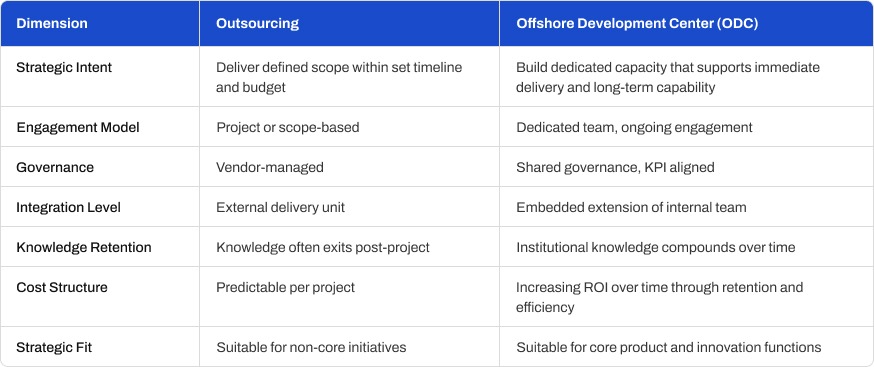
Understanding the structural differences between outsourcing and an Offshore Development Center (ODC) requires examining strategic intent, time horizon, and governance integration. These dimensions determine whether offshore capability remains transactional or becomes a long-term growth engine.
1. Strategic Intent
The primary difference in the ODC vs outsourcing comparison lies in strategic purpose.
Outsourcing is typically designed to:
- Execute predefined tasks within agreed scope, budget, and timeline
- Reduced trust in AI systems
- Support clearly defined initiatives or pilot projects
- Address temporary workload fluctuations
An Offshore Development Center (ODC) is structured to:
- Provide dedicated engineering capacity aligned with business priorities
- Stabilize immediate delivery pressure
- Build long-term engineering capability
- Strengthen the company’s operating model over time
Outsourcing often solves execution gaps within a defined boundary.
An ODC combines short-term delivery support with structural capability development aligned to multi-year product and technology roadmaps.
If the objective is purely transactional execution, outsourcing can be efficient.
If the objective is delivery stability with scalable engineering infrastructure, an ODC offers stronger structural alignment.
2. Time Horizon and Continuity
The second structural difference concerns continuity and integration depth.
In an outsourcing model:
- Engagements often conclude once the project is delivered
- Continuity depends on contract renewal
- Knowledge transfer may occur at project closure
In an ODC model:
- Offshore teams remain embedded across multiple release cycles
- Collaboration continues through product iterations and strategic pivots
- Institutional knowledge deepens over time
- Delivery predictability improves as integration stabilizes
Importantly, ODCs are not limited to long-term initiatives. They allow organizations to respond quickly to short-term delivery demands while preserving execution continuity and long-term stability.
For product-driven enterprises, this balance between immediate responsiveness and sustained integration directly impacts innovation velocity and operational resilience.
3. Governance and Control
Governance structure significantly differentiates outsourcing from an Offshore Development Center (ODC).
In an outsourcing model:
- Vendors manage day-to-day execution
- Performance is measured primarily against milestones or service-level agreements (SLAs).
- Strategic visibility and decision-making authority often remain limited
The vendor is responsible for delivery, but alignment with long-term business direction may be minimal.
In an ODC model:
- Governance is shared between onshore and offshore leadership
- Offshore teams participate in sprint planning, performance reviews, and roadmap discussions
- KPIs are aligned with business objectives, not just project completion
This shared accountability creates stronger transparency, tighter strategic alignment, and lower misalignment risk over time.
4. Knowledge Retention and Intellectual Capital
Knowledge continuity is one of the most underestimated differences in the ODC vs outsourcing comparison.
With outsourcing:
- Knowledge transfer often occurs at the end of a project
- Context may leave with the vendor team
- Architectural familiarity can be fragmented across engagements
Over time, this limits compounding expertise.
With an ODC:
- Engineers remain embedded across multiple development cycles
- Domain knowledge deepens with each iteration
- Architectural decisions are documented and refined internally
This continuity protects intellectual capital and accelerates future development cycles.
For organizations investing heavily in AI systems, cloud-native platforms, cybersecurity frameworks, or enterprise infrastructure, institutional memory becomes a measurable competitive advantage rather than an operational detail.
5. Cost Efficiency vs Cost Scalability
Cost is central to any offshore decision, but the economic logic differs between the two models.
Outsourcing offers:
- Predictable pricing per project
- Lower short-term commitment
- Flexibility for isolated initiatives
It is optimized for immediate expenditure control.
An ODC offers:
- Lower cost compared to fully in-house hiring in high-cost markets
- Increasing return on investment as retention stabilizes
- Higher productivity as domain knowledge compounds
As teams mature and onboarding friction decreases, the effective cost per output declines over time.
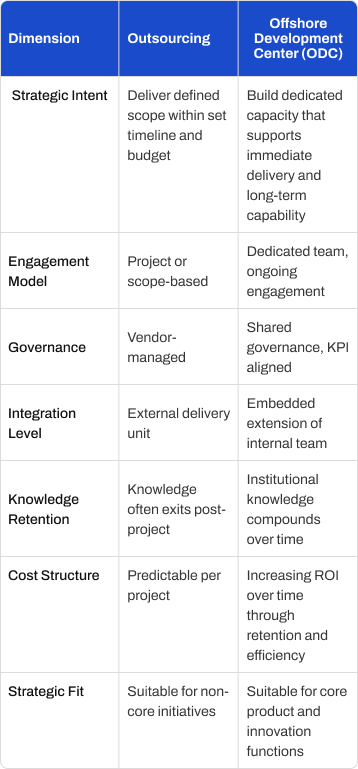
Comparison Overview
When Outsourcing Is the Right Choice
Outsourcing is appropriate when:
- The project scope is fixed and clearly defined
- The initiative is experimental or non-core
- Delivery timelines are short-term
- Internal leadership resources are limited
In these scenarios, the transactional model provides efficiency without long-term structural commitment.
When an ODC Becomes a Strategic Advantage
An Offshore Development Center is more suitable when:
- Technology is central to competitive positioning
- Product development is continuous and iterative
- Local hiring constraints limit scalability
- Specialized expertise is required long-term
- Governance and integration are prioritized
Many enterprises across Singapore and Southeast Asia are adopting structured ODC models as part of broader digital transformation initiatives. In these cases, offshore capability is not a cost tactic but a resilience strategy.
The Risk of Mislabeling
Some organizations believe they have built an ODC when, in reality, they are operating extended outsourcing contracts. Without shared KPIs, integrated governance, and long-term roadmap alignment, the offshore function remains external in mindset and operation.
An ODC without structural integration behaves like outsourcing, regardless of contract terms.
Clarity in model design determines outcome quality.
The BeyondEdge Approach
At BeyondEdge , we view Offshore Development Centers as structured execution platforms rather than staffing solutions. Our approach emphasizes governance design, cultural integration, and long-term capability alignment with business objectives. We work with enterprises to ensure offshore teams are not isolated delivery units, but embedded contributors to product innovation and operational scalability. Because in a competitive digital environment, sustained capability matters more than temporary efficiency.Final Perspective
The decision between ODC vs outsourcing should not be framed purely around cost comparison. It should be grounded in strategic intent.
While outsourcing is effective for defined execution needs, an ODC is better suited for building scalable engineering strength. Organizations that thoughtfully differentiate between the two models position themselves for more predictable innovation and stronger long-term growth.
If your business is evaluating an offshore strategy, the real question is not which option is cheaper, but which model best supports your operating architecture over the next five years, and that distinction makes all the difference.
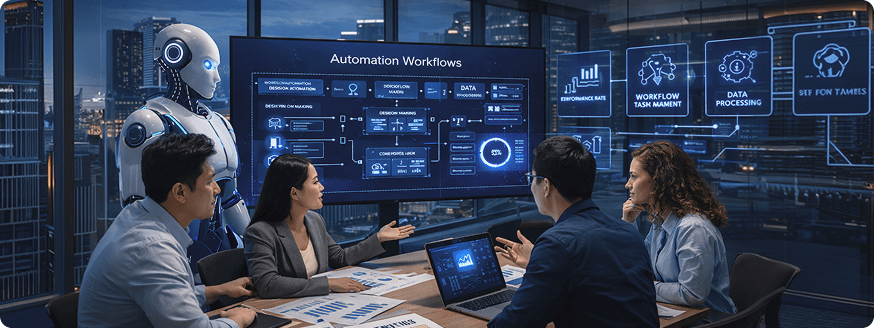
AI agents are quickly becoming a core part of modern software development and business operations. From automating workflows to supporting decision-making, they promise significant gains in productivity. But in practice, many organizations are discovering a gap between expectation and reality.
AI agents don’t fail because the technology is not advanced enough.
They fail because they lack the right context, structure, and performance management systems to operate effectively.
The Rise of AI Agents in Modern Organizations
AI agents are designed to perform tasks autonomously, often powered by large language models and integrated into workflows, tools, and internal systems.
In theory, this enables:
- Automated execution of complex workflows
- Continuous task handling without constant human input
- Scalable productivity across teams
However, as organizations begin to scale AI usage, a new challenge emerges: performance inconsistency.
AI agents may perform well in simple tasks, but struggle with:
- Multi-step workflows
- Ambiguous instructions
- Evolving business requirements
This highlights a critical insight: AI agents are only as effective as the context they operate within.
The Hidden Limitation: Context Management
One of the most overlooked challenges in AI implementation is context management.
AI agents rely heavily on:
- Input data
- Historical interactions (memory)
- Clear task definitions and constraints
As tasks become more complex, context becomes harder to manage.
Without proper structure, AI agents may:
- Miss critical information
- Misinterpret instructions
- Generate inconsistent or low-quality outputs
This is particularly evident in software development environments, where tasks often span multiple systems, dependencies, and iterations. The result is not a failure of AI capability but a failure of system design.
From AI Output to Business Performance
When AI agents underperform, the impact goes beyond technical inefficiencies. It directly affects business outcomes:
- Increased rework and inefficiency
- Reduced trust in AI systems
- Slower execution and decision-making
Many organizations expect AI to deliver immediate value, but underestimate the infrastructure required to support it. As a result, AI becomes:
As a result, companies are caught between:
- Difficult to scale
- Inconsistently applied
- Underutilized across teams
This is where the conversation must evolve from tools to performance.
AI Agents Need Performance Management Just Like Humans
Interestingly, the challenges of managing AI agents mirror those of managing human teams. In traditional workforce systems, performance depends on:
- Clear goals and KPIs
- Defined responsibilities
- Continuous feedback and iteration
- Structured evaluation processes
The same principles apply to AI. To ensure consistent results, organizations must:
- Define performance metrics for AI outputs (accuracy, completion rate, efficiency)
- Build feedback loops to improve results over time
- Combine AI execution with human oversight where necessary
- Continuously refine workflows and instructions
AI is not replacing performance management, it is extending it into a new domain.


The Real Gap: Execution and System Design
Despite growing investment in AI, many organizations still approach it as a tool adoption problem. In reality, it is an execution and system design challenge.
Common gaps include:
- Lack of structured frameworks for managing AI agents
- Poor integration between AI outputs and business workflows
- Limited resources to build and maintain AI systems
- Over-reliance on internal teams without scalable support
This leads to fragmented implementation where AI exists, but fails to deliver consistent value.
A More Scalable Approach: Structured and Flexible Execution
To unlock the full potential of AI agents, companies need a more structured and scalable approach. This includes:
- Designing systems that manage context effectively
- Establishing clear performance metrics
- Creating feedback loops between AI and human teams
- Scaling technical capabilities without overloading internal resources
This shift requires not just new tools but new operating models.
Execution, Not Technology, Will Define AI Success
As AI agents become more integrated into business operations, the defining factor of success will not be access to technology. It will be:
- How well systems are designed
- How effectively performance is managed
- How scalable execution models are implemented
Companies that treat AI as a standalone tool will struggle to scale. Those that treat it as part of a broader execution system will gain a lasting competitive advantage.
Conclusion: AI Agents Are Only as Strong as the Systems Behind Them
AI agents represent a powerful shift in how work is executed.
But they do not operate in isolation.
Without proper context, structure, and performance management, even the most advanced AI systems will fall short.
For organizations, the opportunity lies not just in adopting AI but in building the systems that allow it to perform consistently and at scale.
Build High-Performing AI Systems with BeyondEdge
AI agents alone don’t drive results, execution does.
BeyondEdge helps companies design, build, and scale AI-powered systems through flexible Offshore Development Center (ODC) models.
Whether you’re:
- Developing AI-driven products
- Scaling engineering capabilities
- Or improving system performance
We provide the structure, talent, and scalability to help you execute with confidence.
Connect with BeyondEdge to build scalable, high-performing AI systems
Singapore is accelerating its position as a regional leader in artificial intelligence. With national initiatives to build an AI-ready workforce in Singapore and train 100,000 AI-skilled professionals, the foundation for large-scale transformation is already in place.
But while AI adoption in Singapore companies is gaining momentum, many organizations are encountering a different challenge.
The real question is no longer whether to adopt AI. It is how to implement it effectively while managing workforce transformation at scale.
AI Adoption in Singapore Is Accelerating
Across industries, AI adoption Singapore is becoming a business imperative. From automating workflows to enhancing decision-making, companies are investing heavily in AI technologies to remain competitive. At the same time, the government is actively supporting:
- AI skills development across the workforce
- Enterprise-level AI implementation
- Workforce transformation programs
This has created a strong ecosystem for innovation. However, access to tools and training does not automatically translate into successful implementation.
The Real Challenge: AI Workforce Transformation
AI is often viewed as a technology upgrade. In reality, it is a workforce transformation challenge. As explored in our earlier perspective on the human side of AI in the workplace, AI reshapes not only tasks, but also roles, expectations, and team dynamics.
Now, companies must move beyond understanding the impact, and focus on execution. This includes:
- Redesigning roles to integrate AI capabilities
- Upskilling employees in practical, applicable ways
- Ensuring business continuity during transition
Without this alignment, AI initiatives risk becoming fragmented and underutilized.
The AI Talent Gap in Singapore
Despite strong investment in training, a significant AI talent gap in Singapore remains. Organizations are facing:
- Difficulty hiring AI-skilled professionals fast enough
- Increasing competition for technical talent
- Mismatch between available skills and business needs
Traditional hiring models are struggling to keep pace with the speed of change.
As a result, companies are caught between:
- The urgency to implement AI
- The limitations of their existing workforce structure
This gap is not just about talent availability , it is about how talent is deployed.
Why Companies Struggle with AI Implementation
Even with the right intent, many organizations face similar AI implementation challenges:
1. AI Tools Without Workforce Integration
Companies adopt AI technologies but fail to redefine how teams should work with them.
2. Upskilling Without Application
Employees gain new AI skills, but lack opportunities to apply them effectively in real workflows.
3. Slow and Rigid Hiring Processes
Traditional recruitment cycles are not designed for rapidly evolving AI skill demands.
4. Limited Scalability
Building in-house AI teams requires significant time, cost, and long-term commitment.
These challenges highlight a critical issue: AI transformation is not limited by technology, it is limited by execution capability.


Building AI-Ready Teams with Flexible Talent Models
To address the AI workforce transformation in Singapore, companies are beginning to rethink how teams are structured.
A more adaptive model is emerging , one that prioritizes:
- Skills over roles
- Flexibility over fixed headcount
- Scalability over long-term hiring constraints
This includes:
- Leveraging external partners for specialized expertise
- Building hybrid teams that combine internal and external talent
- Scaling technical capabilities based on project needs
Such approaches allow organizations to respond faster to change while minimizing operational risk.
Execution Will Define Competitive Advantage
As AI workforce transformation in Singapore continues to accelerate, the gap between strategy and execution will become more pronounced.
The companies that succeed will not necessarily be those that adopt AI first.
They will be those that:
- Align AI adoption with workforce strategy
- Build scalable and flexible talent models
- Execute transformation without compromising business performance
Those that fail to address these areas risk investing in AI without realizing its full potential.
Conclusion: From AI Strategy to Workforce Execution
Singapore has created a strong foundation for AI-driven growth. The tools, talent pipelines, and policy support are already in place. The next phase is execution.
For organizations, this means moving beyond high-level AI strategies and focusing on how teams are built, scaled, and managed in an AI-driven environment. Because ultimately, AI workforce transformation is not just about technology, it is about how effectively companies redesign their workforce to make that technology work.
Build Your AI-Ready Team with BeyondEdge
AI transformation doesn’t have to disrupt your business.
At BeyondEdge, we help companies in Singapore and across the region build scalable, AI-ready teams through flexible Offshore Development Center (ODC) models.
Whether you’re:
- Exploring AI adoption
- Scaling your technical capabilities
- Or navigating workforce transformation
We provide the talent and structure to help you move faster, with less risk.
Start building your AI-ready team today
Connect with BeyondEdge to explore how our scalable talent solutions can support your growth.
In Budget 2026, Singapore made its position clear: artificial intelligence is no longer just a technology trend. It is now a strategic pillar of national competitiveness.
Prime Minister and Finance Minister Lawrence Wong outlined a comprehensive plan to strengthen Singapore’s AI ecosystem, spanning governance, industry deployment, enterprise adoption, infrastructure, and workforce development.
For businesses operating in Singapore and across Southeast Asia, these announcements signal a structural shift in how innovation, productivity, and growth will be driven in the coming years.


AI as a National Directive
Budget 2026 frames AI as a long-term economic capability, not a short-term innovation initiative.
At the centre of this strategy is the creation of a National AI Council, an inter-ministerial body tasked with setting direction for Singapore’s AI agenda, coordinating regulations, and accelerating the deployment of AI solutions across the economy.
This move reflects a broader ambition: to institutionalise AI at a national level, ensuring alignment between policy, industry, and workforce development. Rather than leaving adoption solely to market forces, Singapore is building coordinated structures to guide how AI is developed and applied.
Sector – Focused AI Missions
A key pillar of the strategy is the launch of National AI Missions, overseen by the AI Council. These missions will prioritise AI development and deployment in four sectors with strong growth potential and real-world impact:
- Advanced manufacturing
- Connectivity
- Finance
- Healthcare
The goal is to accelerate testing, scaling, and commercialisation of AI solutions in areas where Singapore already has strong capabilities – helping transform research into operational outcomes.
For enterprises, this creates clearer pathways to participate in sector-specific AI initiatives and innovation programmes.
Stronger Support for Enterprise AI Adoption
To help businesses move from experimentation to implementation, Budget 2026 introduces several enhancements:
Instead, companies will need to focus on:
- Expansion of the Enterprise Innovation Scheme in 2027 and 2028, allowing companies to claim up to 400% tax deductions or allowances on qualifying AI-related expenditure
- Introduction of a Champions of AI programme, providing tailored support for firms aiming to transform operations through AI, including workforce training and enterprise redesign
- Broader coverage under the Productivity Solutions Grant, extending support to more AI-enabled tools and solutions
Together, these measures are designed to lower barriers to adoption while encouraging companies to integrate AI into core business processes.
A New AI Park at One-North
To strengthen Singapore’s innovation ecosystem, JTC will establish a dedicated AI park at one-north.
Located near existing research clusters, the park will serve as a hub for AI startups, researchers, and enterprises to collaborate, pilot solutions, and scale new technologies. It builds on earlier initiatives such as Lorong AI, creating physical infrastructure to support the country’s growing AI economy. This reinforces Singapore’s approach of combining policy, talent, and place-making to accelerate innovation.


Investing in AI Skills and Workforce Readiness
Beyond technology and incentives, Budget 2026 places strong emphasis on people. Key workforce initiatives include:
- Expansion of the TechSkills Accelerator to support AI training for non-tech professions, beginning with accountancy and legal sectors
- Six months of free access to premium AI tools for Singaporeans enrolled in selected AI courses via the MySkillsFuture portal
- Redesign of MySkillsFuture to make AI learning pathways clearer and more accessible
- Strengthening AI literacy across institutes of higher learning
These efforts aim to embed AI capability across the broader workforce – not just among engineers and data scientists.
What This Means for Businesses
Taken together, these initiatives reflect a clear national direction: AI is becoming part of Singapore’s economic infrastructure.
For organisations, this has several implications:
- AI adoption will increasingly become a baseline expectation, not a competitive differentiator on its own
- Operational readiness – including data quality, system integration, and workflow clarity – will determine how effectively AI can be deployed
- Companies will need to move beyond pilots and proofs of concept toward structured, scalable implementation
- Workforce upskilling will be as critical as technology investment
Preparing for the Next Phase of Growth
Singapore’s Budget 2026 signals a shift from AI exploration to AI execution.
With national governance, sector missions, enterprise incentives, physical infrastructure, and skills development moving in parallel, the ecosystem is being shaped for long-term, applied intelligence. For businesses, this is an opportunity to align strategy with a rapidly evolving environment – building systems, teams, and operating models that are ready for an AI-enabled future.
The message is clear: future-ready organisations will be defined not by how quickly they adopt AI, but by how deeply they integrate it into how they work.
Source: The Straits Times – Budget 2026: 6 ways Singapore will invest in building its AI strengths
Singapore’s Budget 2026 introduces significant changes to foreign workforce policies, including higher qualifying salaries for Employment Pass (EP) and S Pass holders, alongside increases to the Local Qualifying Salary (LQS). Announced by Prime Minister Lawrence Wong and reported by Channel NewsAsia, these measures signal a continued shift toward a higher-skilled, higher-wage economy – while ensuring Singaporeans remain at the centre of workforce policies.
For businesses operating in Singapore, this is more than a regulatory update. It marks a structural change in cost dynamics, talent strategy, and operational planning.


Key Workforce Changes Under Budget 2026
From January 2027, qualifying salaries will increase as follows:
1. Employment Pass (EP): Minimum salary rises from S$5,600 to S$6,000 (Financial services: S$6,200 → S$6,600)
2. S Pass: Minimum salary rises from S$3,300 to S$3,600 (Financial services: S$3,800 → S$4,000)
These changes will apply to:
- New EP and S Pass applications from 1 January 2027
- Renewals from 1 January 2028
In addition, the Local Qualifying Salary (LQS) for full-time local employees will increase from S$1,600 to S$1,800 from July 2026. Firms that hire foreign workers must meet this minimum for local staff.
The government will also enhance co-funding under the Progressive Wage Credit Scheme to support employers adjusting to wage increases, with higher support levels in 2026 and extended coverage through 2028.
Beyond Policy: A Structural Shift in Business Operations
Taken together, these changes reshape how companies think about growth. Talent costs are rising – not only for foreign professionals, but across the local workforce. At the same time, levies for work permit holders in selected sectors will increase, and dependency ratio tiers in services and manufacturing will be simplified.
The broader implication is clear: Growth in Singapore can no longer rely primarily on headcount expansion.
Instead, companies will need to focus on:
- Smarter workforce allocation
- Higher productivity per employee
- Leaner organizational structures
- Greater reliance on technology and automation
- Clearer role design and operational accountability
This reflects the government’s broader direction: linking wages to skills, productivity, and career progression – rather than adopting a flat minimum wage approach.


What This Means for Technology-Driven Organisations
For tech-enabled businesses, Budget 2026 reinforces a reality already felt on the ground: Operational efficiency is becoming a competitive advantage.
As labour costs rise, sustainable growth increasingly depends on:
- Integrated systems that improve visibility across finance, operations, and leadership
- Automation to reduce manual overhead
- Distributed or hybrid delivery models to balance cost and capability
- Keeping local teams focused on strategy, clients, and high-value decision making
Companies that adapt early will be better positioned to absorb higher costs while maintaining speed and quality. Those that delay risk seeing margins compressed and execution slowed.
Preparing for the Next Phase of Growth
Singapore’s approach remains balanced: staying open to global talent while strengthening opportunities for locals and ensuring fair wage progression.
For businesses, this means planning beyond short-term hiring needs. It requires rethinking operating models, investing in productivity tools, and building organisations that scale through systems, not just people. Budget 2026 is a reminder that future-ready companies are built through structure, discipline, and technology-enabled execution.
Source: Channel NewsAsia – Budget 2026 workforce policy announcements


1. Growing SMEs with Increasing Operational Complexity
Small and medium-sized enterprises often begin with basic tools such as accounting software, spreadsheets, and
standalone CRM systems. While this setup works in early stages, problems emerge as transaction volumes increase and
teams expand.
ERP becomes essential for growing SMEs when:
- Financial data is spread across multiple systems
- Manual reconciliation consumes excessive time
- Management lacks real-time visibility into performance
By centralizing core business functions, ERP enables SMEs to scale without increasing operational friction or error rates.
2. Businesses with Multiple Departments or Locations
Organizations operating across multiple departments or locations face coordination challenges when using traditional
software. Each function may work in isolation, leading to inconsistent data and delayed reporting.
ERP is especially valuable for businesses that:
- Operate across branches, regions, or countries
- Require standardized processes across teams
- Need consolidated reporting at the management level
With ERP, data flows in real time across departments, ensuring leadership has a unified view of operations regardless of
location.
3. Companies Managing High Transaction Volumes
As transaction volumes grow, traditional systems often struggle with performance, accuracy, and reporting speed. Manual
processes increase the risk of errors and delays, particularly in finance and inventory management.
ERP is critical for businesses that:
- Process large numbers of sales or purchase transactions
- Manage complex inventory or supply chains
- Require accurate, real-time financial reporting
ERP systems are built to handle scale, allowing operations to grow without compromising data integrity or efficiency.


4. Businesses in Regulated or Risk-Sensitive Industries
Organizations operating in regulated industries face additional requirements around compliance, auditability, and data
governance. Traditional tools often lack the controls needed to manage these risks effectively.
ERP is well-suited for businesses that require:
- Structured approval workflows
- Audit trails and compliance reporting
- Strong internal controls across financial and operational processes
By embedding governance into daily operations, ERP reduces risk while improving transparency and accountability.
5. Companies Planning for Regional or International Expansion
Expansion introduces new levels of complexity, including multi-currency transactions, tax compliance, and cross-border
reporting. Managing this with disconnected systems increases both cost and risk.
ERP becomes essential when businesses plan to:
- Enter new regional or international markets
- Manage multiple currencies and regulatory frameworks
- Maintain consistent reporting standards across entities
A scalable ERP foundation allows expansion without constant system rework.
6. Businesses Moving from Operational Management to Strategic Growth
Traditional business software supports task execution but provides limited insight into long-term performance trends. As
companies mature, leadership requires data that supports strategic decision-making rather than reactive management.
ERP supports this transition by:
- Consolidating operational data into actionable insights
- Enabling forecasting and performance analysis
- Aligning daily activities with long-term business goals
This shift is particularly important for leadership teams focused on sustainable growth rather than short-term execution.
Where BeyondEdge Fits in ERP Adoption
Identifying the need for ERP is only the first step. Successful adoption depends on aligning technology with business
objectives and operational realities.
BeyondEdge works with organizations to assess when ERP becomes necessary and how it should be implemented to support growth, governance, and scalability. Rather than viewing ERP as a standalone system, BeyondEdge focuses on building integrated operational foundations that evolve with the business.
Through a structured, business-led approach, BeyondEdge helps companies:
- Transition smoothly from traditional systems to ERP
- Improve visibility across finance and operations
- Reduce operational risk as complexity increases
- Build a scalable platform for long-term growth
Final Thoughts
Not every business needs ERP from day one. However, many businesses delay ERP adoption until inefficiencies and risks
become costly.
Companies that experience rapid growth, operational complexity, regulatory pressure, or expansion plans are the ones that benefit most from ERP. With the right timing and approach, ERP becomes a strategic asset rather than a reactive fix.
At BeyondEdge ERP is positioned as a foundation for clarity, control, and sustainable growth, enabling businesses to
move beyond operational limits and focus on what matters most.
The real difference between ERP and traditional business software lies in integration, data visibility, and scalability. While traditional tools manage individual business functions in isolation, ERP connects finance, operations, sales, and data into a single system, enabling better control, real-time insights, and sustainable growth as businesses scale.
This is usually the moment when leaders begin asking a critical question:
Should we continue managing with disconnected tools, or is it time to move to an ERP system?
Understanding the difference between ERP and traditional business software is essential for making the right long-term decision.


1. System Integration vs. Standalone Applications
Traditional business software is typically designed to solve individual problems. One tool for accounting, another for customer management, another for inventory, and often spreadsheets to fill the gaps. Each system may work well on its own, but together they require constant switching, manual updates, and repeated data entry.
ERP, or Enterprise Resource Planning, takes a fundamentally different approach. Instead of separate tools, ERP provides a single, integrated system that connects core business functions such as finance, sales, procurement, HR, inventory, and operations.
The result is not just convenience. It is operational consistency. Teams work within one shared environment, using the same data, processes, and standards across the organization.
2. Real-Time Data Visibility vs. Information Silos
One of the biggest limitations of traditional software is fragmented data. Sales may close deals, but finance only becomes aware after reports are manually shared. Inventory levels may drop, but operations only notice when shortages begin to affect customers. Decisions are made based on delayed or incomplete information.
ERP systems eliminate this gap. Data flows automatically across departments in real time. When a sale is confirmed, revenue is recorded, inventory is updated, and management dashboards reflect the change instantly.
This real-time visibility enables faster responses, better coordination, and more confident decision-making. Instead of reacting to problems after they occur, businesses can anticipate and prevent them.
3. Scalability for Growth vs. Systems That Break Under Pressure
Traditional tools often perform well at a small scale. But as transaction volumes increase, teams grow, or new markets are entered, these systems begin to show limitations. Reports slow down, errors become more frequent, and operational friction increases.
ERP systems are designed with scalability in mind. Whether a business opens a new branch, expands across borders, or significantly increases headcount, ERP frameworks can adapt without disrupting core operations.
For fast-growing companies in Southeast Asia, where expansion often happens quickly, this scalability is not optional. It is a requirement for sustainable growth.


4. Stronger Control, Compliance, and Business Confidence
Business leaders need more than raw numbers. They need confidence in the accuracy of their data, assurance that processes are compliant, and transparency into how decisions are made.
Traditional software often provides fragmented views with limited control mechanisms. ERP systems, by contrast, offer structured workflows, built-in approvals, audit trails, and standardized reporting.
This level of control supports better governance, reduces risk, and ensures that leadership decisions are backed by reliable data rather than assumptions or manual reconciliations.
5. From Task Execution to Strategic Business Insight
At its core, traditional business software helps companies complete tasks. Record transactions, send invoices, manage contacts. While necessary, these functions are largely operational.
ERP goes beyond task execution. By consolidating data across the organization, ERP systems transform daily activities into actionable insights. Businesses can identify trends, forecast demand, optimize costs, and align operations with long-term strategy.
This shift from operational management to strategic intelligence is where ERP delivers its greatest value.
6. Total Cost of Ownership Over Time
While traditional software may appear more affordable initially, hidden costs often emerge over time. These include manual reconciliation, system maintenance, integration efforts, and operational inefficiencies.
ERP centralizes systems and processes, reducing long-term complexity and operational overhead. When evaluated over time, ERP often delivers stronger return on investment for growing businesses.
Where BeyondEdge Fits in the ERP Journey
Choosing ERP is not simply a technology decision. It is a strategic step toward building a more connected, scalable, and resilient organization.
This is where BeyondEdge comes in.
BeyondEdge works with businesses to help them transition from fragmented systems to integrated ERP environments that align with real operational needs and long-term goals. Rather than treating ERP as a standalone solution, BeyondEdge focuses on how ERP supports business strategy, governance, and sustainable growth.
For growing organizations in Southeast Asia, BeyondEdge emphasizes:
- Practical ERP adoption tailored to business scale and complexity
- Integrated systems that improve visibility across finance, operations, and leadership
- Scalable architectures that support expansion without added operational burden
- Data-driven decision-making built on reliable, real-time information
By focusing on both technology and business outcomes, BeyondEdge helps organizations move beyond operational limitations and build with confidence.
Final Thoughts
The real difference between ERP and traditional business software is not about features. It is about how a business operates, scales, and makes decisions.
Traditional tools help companies manage day-to-day tasks. ERP connects the entire organization into a single, intelligent system that supports long-term growth. With the right approach and the right partner, ERP becomes more than software. It becomes a foundation for clarity, control, and competitive advantage.
At BeyondEdge, ERP is seen not as an endpoint, but as a platform to help businesses move beyond today’s challenges and prepare for tomorrow’s opportunities.